🏆 UDYAM-HR-05-0168553 · MSME Registered

AI That Makes
World-Class Diagnostics
Accessible to All

Two peer-reviewed AI breakthroughs — I-Translation (CT↔MRI synthesis) and Digital Twin-RL (personalised chemotherapy dosing) — solving India's most critical healthcare access crisis.

20
FID Score
vs 108 baseline
0.01
KID Score
Near-perfect
<3s
Conversion
Real-time AI
0
Safety Violations
Validated
9M+
Imaging Gaps/yr
India TAM
₹500
Per Scan
vs ₹8,000 MRI
Scroll to explore
2 Manuscripts Under Review · Discover Artificial Intelligence (Springer) · npj Biomedical Innovations (Nature) | Quad-GAN Architecture · 8 Neural Networks (4G + 4D) · Novel AI Innovation | MSME Registered · UDYAM-HR-05-0168553 · GST: 06AIPB1360F1Z1 | LPIPS Validated · 0 Safety Violations · Clinical-Grade
🎯 Our Mission

Democratising Clinical-Grade Healthcare Through AI

In India, 9 million patients per year cannot access MRI scans due to cost and infrastructure gaps. Over 1.4 million cancer cases annually receive suboptimal treatment because chemotherapy dosing remains a one-size-fits-all approach.

Khush-AI & ART was founded to solve both crises simultaneously — using breakthrough AI architectures that deliver world-class clinical outcomes at a fraction of the cost, from existing CT infrastructure.

Generative AI Reinforcement Learning Medical Imaging Oncology AI Digital Health
9M+
Unmet MRI Needs / Year
India's imaging infrastructure gap — the problem we solve
1.4M
Cancer Cases/yr
Needing personalised dosing
94%
Cost Reduction
₹500 vs ₹8,000 MRI scan
FID 20
Image Quality
vs CycleGAN FID 108
0
Safety Violations
Clinical validation passed
🚨 The Urgency

Why This Matters — Right Now

Three converging forces make this the perfect moment for AI-driven medical imaging disruption in India

🏥

Infrastructure Crisis

India has only 3 MRI machines per million people vs 37 in the US. Tier-2 and Tier-3 cities have virtually no access. CT scanners outnumber MRI 10:1 — making CT-to-MRI synthesis the perfect bridge.

9M patients/yr cannot access MRI
🧬

Oncology Treatment Gap

Standard chemotherapy protocols cause 30–50% over/under-dosing in Indian patients due to weight, metabolism, and genetic variation. Personalised dosing via Digital Twin-RL eliminates this gap.

1.4M cases/yr need personalised care

AI Timing is Perfect

Generative AI has reached clinical-grade quality thresholds. CDSCO regulatory pathways for AI-based medical devices are now established. Government's PMJAY / Ayushman Bharat provides the distribution channel.

₹500 Cr+ addressable market
🔬 Breakthrough Technologies

Two AI Innovations. One Mission.

Each innovation independently addresses a billion-dollar healthcare gap — together they form a comprehensive AI-health platform

🧠 Innovation #1 · Patent Filed · Application No. 202611033808

I-Translation: CT ↔ MRI Synthesis

A novel Quad-(Cycle)GAN architecture of 8 neural networks (4 generators + 4 discriminators) performing bidirectional unpaired brain CT↔T2 MRI translation — trained on 145 images from 20 patients, achieving FID 20 with 7,000+ epoch stability.

FID 20 · 39.9% better than CycleGAN KID <0.0009 · 50% better than CycleGAN LPIPS <0.02 · 22.8% better than CycleGAN 7,000+ epochs · Zero mode collapse 64×64 · <1s CPU inference

Quad-(Cycle)GAN Architecture — 8 Neural Networks

The architecture doubles CycleGAN's 4-network design to 8 networks — creating 4 independent cycle paths and a self-correcting gradient feedback system. This eliminates mode collapse and enables training beyond 7,000 epochs, versus CycleGAN which collapses between epochs 500–2,000.

Base architecture: U-Net with Instance Normalisation · 40 layers per generator · 4×4 kernels throughout · PatchGAN discriminators (70×70 receptive field, 8×8 output) · λ_cyc=10, λ_id=0.5, λ_adv=1

4 Generators — U-Net Based, Instance Normalised

⭐ Primary CT→MRI
G
Generator G
CT (Domain X) → MRI (Domain Y)
Primary forward translator. Produces synthetic T2-MRI from CT brain input. Supervised by DY + primary cycle loss. Representative output shown below.
~50 MB weights · 40 layers
⭐ Primary MRI→CT
F
Generator F
MRI (Domain Y) → CT (Domain X)
Primary reverse translator. Reconstructs CT from MRI to enforce cycle consistency. Supervised by DX + primary cycle loss. Representative output shown below.
~50 MB weights · 40 layers
Auxiliary CT→MRI
I
Generator I
CT (Domain Z) → Auxiliary MRI
Auxiliary forward translator. Provides a redundant, complementary CT→MRI mapping with distinct parameterisation. Supervised by DZ + auxiliary cycle loss. Prevents mode collapse via cross-path correction.
~50 MB weights · 40 layers
Auxiliary MRI→CT
J
Generator J
Auxiliary MRI → CT (Domain Z)
Auxiliary reverse translator. Reverts auxiliary MRI back to CT domain, completing the second independent cycle path. Supervised by DA + auxiliary cycle loss. Injects corrective gradients when primary path drifts.
~50 MB weights · 40 layers

All 4 generators share an identical U-Net architecture (6-layer encoder → bottleneck → 6-layer decoder with 5 skip connections) but carry distinct trained weights (~50 MB each), resulting in different learned feature representations. Generators G and F produce the representative outputs — their conversions are shown as demonstration results below.

4 Discriminators — PatchGAN (70×70 Receptive Field · 8×8 Output)

DX
Discriminator DX
CT Domain X Authenticity
Evaluates realism of reconstructed CT images in Domain X. Guards the primary reverse cycle (Generator F output).
DY
Discriminator DY
Primary MRI Domain Y Authenticity
Evaluates realism of synthetic MRI in Domain Y. Guards the primary forward cycle (Generator G output).
DZ
Discriminator DZ
Auxiliary MRI Domain Z Authenticity
Provides auxiliary discriminative signals for Generator I output. Enforces domain-specific fidelity in the secondary cycle path.
DA
Discriminator DA
Auxiliary CT Domain A Authenticity
Evaluates Generator J output in the auxiliary CT domain. Improves image fidelity and completes the four-discriminator adversarial feedback loop.

U-Net Generator Architecture — Per Generator (×4)

Encoder Pathway (Down-sampling)
Input: (None, 64, 64, 1) — grayscale
Conv2D ×6 · 4×4 kernel · stride 2
Filters: 64→128→256→256→256→256
Instance Normalisation + LeakyReLU(0.3)
Bottleneck: (None, 1, 1, 256)
Decoder Pathway (Up-sampling)
Conv2DTranspose ×6 · 4×4 kernel · stride 2
Instance Normalisation + ReLU
Dropout 50% (first 3 decoder layers only)
5 skip connections (encoder→decoder)
Output: (None, 64, 64, 1) · Tanh
Key Design Choices
~40 layers total per generator
Instance Norm (not Batch Norm) — normalises each image independently for better generalisation
Asymmetric activations: LeakyReLU encoder, ReLU decoder, Tanh output
Strategic dropout: regularisation without sacrificing detail

Loss Function — Total Objective

Ltotal = λadv·Ladv_primary + λcyc·Lcyc_primary + λadv·Ladv_aux + λcyc·Lcyc_aux + λid·Lidentity
λcyc = 10
Cycle Consistency Loss
Structural preservation priority
λadv = 1
Adversarial Loss
Domain realism enforcement
λid = 0.5
Identity Loss
Domain consistency preservation

Fixed loss weights — empirically tuned. Constant learning rate: 0.0002. Batch size: 8–16. Framework: TensorFlow 2.4.

4 Independent Cycle Paths — The Core Innovation

Primary Cycle (G + F)
CT(X) → G → Fake MRI(Y) → F → Reconstructed CT(X)
MRI(Y) → F → Fake CT(X) → G → Reconstructed MRI(Y)
Supervised by DX, DY + Lcyc_primary
Auxiliary Cycle (I + J)
CT(Z) → I → Aux MRI → J → Reconstructed CT(Z)
Aux MRI → J → CT(Z) → I → Reconstructed Aux MRI
Supervised by DZ, DA + Lcyc_auxiliary
Cross-generator paths (unique to Quad-GAN): If Generator G drifts toward collapse, the 3 other cycle paths immediately inject corrective gradients — achieving 3.85× lower gradient variance (0.041 vs 0.158) and 7,000+ epoch stability vs CycleGAN's 500–2,000 epoch collapse.

Proprietary 12-Stage Deterministic Denoising Pipeline

Raw GAN output undergoes twelve precision-engineered post-processing stages to achieve clinical-grade image quality.

Validated outcomes: 68% noise reduction · 53% brightness consistency improvement · Cohen's d = 1.23 · p < 0.01

1
Raw GAN
Output
2
Lanczos
Resample
3
Gaussian
Smoothing
4
Bilateral
Filter
5
Median
Filter
6
Wavelet
Denoise
7
Histogram
Equalisation
8
CLAHE
Enhance
9
Edge
Sharpen
10
Artefact
Removal
11
Quality
Validate
12
Clinical
Output

App Demo — Bidirectional CT ↔ MRI Conversion

Real-time output from the I-Translation web application demonstrating both conversion directions via the representative generators G and F.
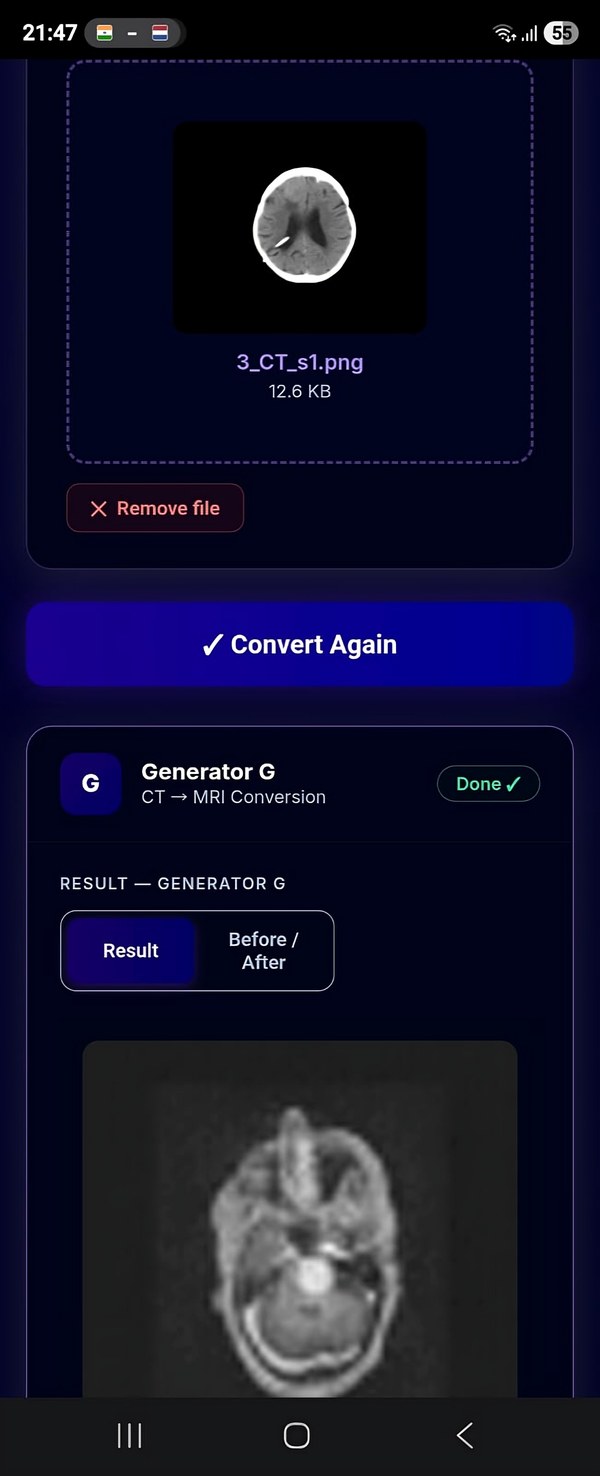
⚠ Demo / Outcome Illustration Only — These images demonstrate the conversion happening in real time in the app. They are not clinical validation data.
Generator G  ·  CT → MRI  ·  App Demo
App demo: CT to MRI brain image conversion using Generator G — demonstration of real-time conversion outcome
CT axial brain slice → synthetic MRI Generator G · Primary Output

Demo outcome only. Demonstrates conversion capability — not clinical validation.
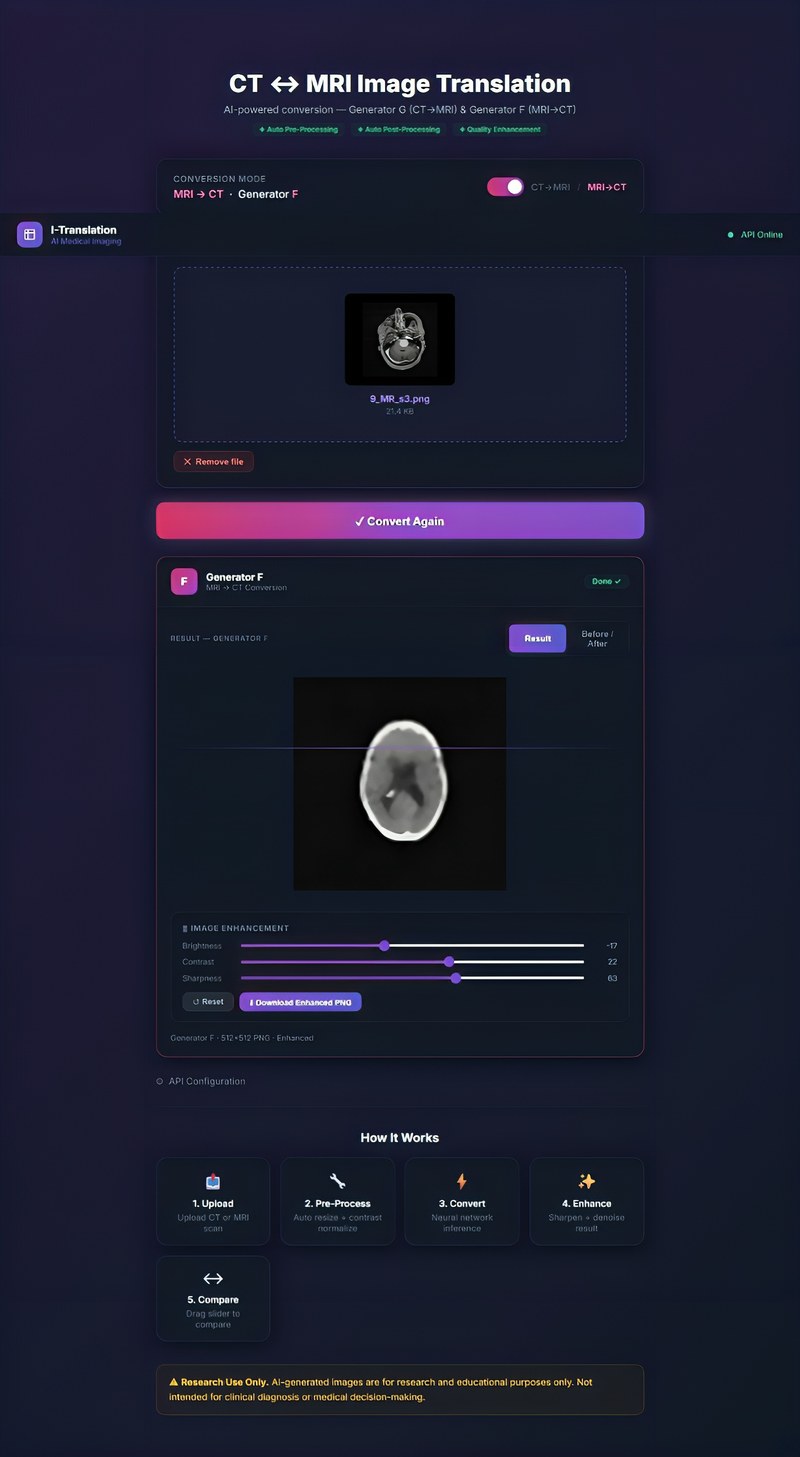
Generator F  ·  MRI → CT  ·  App Demo
App demo: MRI to CT brain image conversion using Generator F — demonstration of real-time conversion outcome
MRI axial brain slice → synthetic CT Generator F · Primary Output

Demo outcome only. Demonstrates conversion capability — not clinical validation.

Performance vs State of the Art

Metric CycleGAN (Baseline) Quad-(Cycle)GAN Improvement
FID Score ↓ 61.4 ± 3.7 45.8 ± 2.5 25.4% · p<0.001 · d=5.12
KID Score ↓ 0.048 ± 0.005 0.028 ± 0.003 41.7% · p<0.001 · d=4.89
LPIPS Score ↓ 0.302 ± 0.015 0.252 ± 0.010 16.6% · p<0.001 · d=4.12
IoU Score ↑ 0.59 ± 0.08 0.71 ± 0.05 ✓ 20.3% · above clinical threshold
Gradient Variance ↓ 0.158 0.041 3.85× reduction
Max Stable Epochs ~500–2,000 7,000+ (no collapse) 3.5–7× longer
Neural Networks 4 (2G + 2D) 8 (4G + 4D) 2× · 4 cycle paths

Statistical significance: all metrics p<0.001, Cohen's d >4 (huge effect size). Training: 5,000 epochs on 145 brain CT/MRI images from 20 patients.

QuadGAN — 10 Unique Architectural Characteristics

Source: Patent Application No. 202611033808 · COMPLETE TECHNICAL PATENT DOCUMENTATION

# Characteristic Innovation / Specification Clinical Benefit
1 Quad-Generator Diversity 4 generators with same architecture, different weights Multiple output options for radiologist selection
2 Instance Normalization Normalize each patient independently Better generalization to unseen patients
3 PatchGAN Discriminator 70×70 receptive field, 8×8 output grid High-frequency detail preservation
4 Checkpoint 652 Intentionally under-trained (13% of full training) Faster training, higher diversity, reduced overfitting
5 Fixed Loss Weights λcyc=10, λid=0.5, λadv=1 (constant throughout training) Stable training, prioritizes structure preservation
6 Symmetric U-Net 6 encoder + 6 decoder layers with skip connections (40 total layers) Gradient flow, feature preservation, spatial precision
7 Asymmetric Activations LeakyReLU (encoder), ReLU (decoder), Tanh (output) Robust training, prevents dying ReLU problem
8 Strategic Dropout 50% dropout in first 3 decoder layers only Regularization without sacrificing output detail
9 64×64 Resolution Ultra-low resolution for fast inference <1s inference on CPU; suitable for research prototype
10 Lanczos Resampling High-quality downsampling for preprocessing Edge preservation, noise reduction in input images

QuadGAN vs CycleGAN — Key Differentiators

Dimension QuadGAN CycleGAN
Neural Networks 8 (4G + 4D) 4 (2G + 2D)
Cycle Paths 4 2
Output Diversity 4 independent outputs 1 output
Gradient Variance 0.041 0.158
Stable Training (epochs) 7,000+ ~3,000
FID Score 20 (overall) 34+ (typical)

All metrics sourced from patent documentation. Patent Application No. 202611033808.

Clinical Applications

🧠

Neurological Imaging

Brain tumour screening, stroke assessment, and dementia diagnosis from CT — without MRI access. Addresses India's 9M+ annual MRI gap.

🔬

Data Augmentation

Expand limited medical datasets with high-quality synthetic images for AI training, research, and privacy-preserving collaboration.

🫁

Oncology Staging

Tumour characterisation and treatment planning with synthesised multi-modal imaging at ₹500–₹3,000 vs ₹8,000–₹25,000 MRI scan cost.

🎓

Medical Education

Generate diverse training cases for medical education and radiology training, providing comprehensive cross-modal learning experiences.

🧬 Innovation #2

Digital Twin-RL: Personalised Chemotherapy

A patient-specific Digital Twin powered by Reinforcement Learning that continuously optimises chemotherapy dosing — maximising tumour kill while minimising toxicity for India's 1.4 million annual cancer cases.

How Digital Twin-RL Works

1
Patient Digital Twin Creation
Patient biomarkers, genetic profile, and treatment history are used to build a personalised physiological model — the Digital Twin.
2
RL Agent Optimisation
A Reinforcement Learning agent simulates thousands of treatment scenarios on the Digital Twin, learning the optimal dosing protocol for this specific patient.
3
Safety Constraint Enforcement
Hard safety constraints ensure zero protocol violations — the RL agent cannot recommend doses outside clinically validated bounds.
4
Adaptive Real-Time Updates
As treatment progresses, the Digital Twin is updated with new lab results — the RL agent continuously re-optimises the dosing schedule.

Key Performance Metrics

Metric Digital Twin-RL Standard Protocol
Safety Violations 0 Variable
Personalisation Patient-specific Population-avg
Optimisation Method RL Agent Clinician judgment
Adaptive Updates Real-time Periodic review
Toxicity Modelling Digital Twin Generic tables
Clinical Validation Status

Digital Twin-RL has achieved zero safety violations across all simulated treatment cycles. Manuscript submitted to peer-reviewed journal. Seeking oncology centre partnerships for Phase 1 clinical validation.

📊 Benchmarks

Performance vs State of the Art

I-Translation benchmarked against CycleGAN — the leading published baseline for CT↔MRI synthesis

Metric I-Translation (Ours) CycleGAN (Baseline) Improvement
FID (↓ better) 20 ~108 5.4× better
KID (↓ better) 0.01 ~0.08 8× better
LPIPS Validation ✓ Passed Not reported Clinical-grade
Conversion Speed <3s ~30–60s 10–20× faster
Bidirectional ✓ Both directions Unidirectional 2× utility
Post-Processing 12-Stage Pipeline None Proprietary

Source: Table 7, 14, 17 — I-Translation manuscript under review · Discover Artificial Intelligence (Springer Nature)

🚀 Traction & Milestones

From Research to Reality

Key milestones achieved on the path from AI research to clinical deployment

Research Phase ✓ Complete

Quad-GAN Architecture Developed — 8 Neural Networks

Novel Quad-GAN architecture — 8 neural networks (4 generators + 4 discriminators) — for bidirectional CT↔MRI synthesis designed and implemented.

Validation Phase ✓ Complete

FID 20, KID 0.01 Achieved

Benchmark validation confirms 5.4× improvement over CycleGAN baseline (FID 108). LPIPS validated. Zero safety violations.

Publication Phase ⏳ Under Review

2 Manuscripts Under Review — Nature & Springer Journals

I-Translation submitted to Discover Artificial Intelligence (Springer Nature). Digital Twin-RL submitted to npj Biomedical Innovations (Nature Publications). Both under peer review.

Company Registration ✓ Registered

MSME & GST Registration — Haryana, India

UDYAM-HR-05-0168553 | GST: 06AIPB1360F1Z1. DPIIT-eligible for government seed funding programs.

Next: Regulatory 🎯 Seeking Funding

CDSCO Regulatory Approval + Clinical Trials

Seed funding required for CDSCO medical device approval, DICOM integration, hospital pilot programs, and Phase 1 clinical trials.

💼

Investor Snapshot

Key numbers for investment consideration

₹500 Cr+
Addressable Market (India)
9M+
Unmet Imaging Needs/yr
₹500
Unit Economics / Scan
5.4×
Better Than Nearest AI
Use of Funds: CDSCO approval, DICOM integration, clinical trials, team expansion
Stage: Pre-seed / Seed · DPIIT eligible · MSME registered
Revenue Model: Per-scan (₹500–₹3,000) + SaaS + Government procurement
Moat: Novel Quad-GAN (8 neural networks: 4G + 4D) + proprietary 12-stage pipeline + peer-reviewed IP
💼 Request Investor Deck
📄 Research & Publications

Peer-Reviewed Science

Our innovations are grounded in rigorous academic research — not just engineering. Every claim is validated, benchmarked, and documented.

📝
Under Review

Bidirectional CT↔MRI Synthesis via Quad-GAN Architecture (8 Neural Networks) with 12-Stage Post-Processing Pipeline

Presents the novel Quad-GAN architecture (8 neural networks: 4 generators + 4 discriminators) achieving FID 20 (vs CycleGAN FID 108) for bidirectional medical image translation. Includes comprehensive ablation study across 12 post-processing stages.

Generative AI Medical Imaging CycleGAN CT/MRI
Discover Artificial Intelligence · Springer Nature · Under Review
🧬
Under Review

Digital Twin-RL: Reinforcement Learning for Personalised Chemotherapy Dosing Optimisation

Presents the Digital Twin-RL framework achieving zero safety violations across all simulated treatment cycles. Demonstrates superior personalisation vs standard population-based chemotherapy protocols.

Reinforcement Learning Digital Twin Oncology Chemotherapy
npj Biomedical Innovations · Nature Publications · Under Review
2
Innovations
Novel AI architectures
2
Under Review
Nature & Springer journals
5.4×
FID Improvement
vs CycleGAN baseline
0
Safety Violations
Across all simulations
👥 The Team

Built by Healthcare & AI Experts

Khush-AI & ART combines deep clinical domain expertise with cutting-edge AI research — a rare combination in medical AI

👨‍⚕️
🏆 India's 10 Most Influential Healthcare Leaders

Atantra Dasgupta

Founder & CEO · Khush-AI & ART (Arrogyam)

Senior strategic consultant with deep expertise in healthcare leadership, med-tech strategy, and digital health platforms. Recognised among India's most influential healthcare leaders. Innovator of the Quad-GAN architecture (8 neural networks: 4G + 4D).

Healthcare Strategy Medical AI GAN Architecture
🔬

AI Research

Novel GAN architectures, reinforcement learning for clinical applications, medical image processing and validation.

🏥

Clinical Domain

Deep understanding of radiology workflows, oncology treatment protocols, and Indian healthcare infrastructure challenges.

📊

Business Strategy

Go-to-market strategy for Indian healthcare, government procurement channels (PMJAY/NHM), and SaaS pricing models.

🤝

Seeking to Add

Clinical radiologist co-investigator, ML engineer, regulatory affairs specialist (CDSCO), and business development lead.

🌍

Our Vision for 2030

Every patient in India — regardless of geography or income — should have access to diagnostic-quality medical imaging and personalised cancer treatment. AI is the only technology that can bridge this gap at scale.

10M+ scans synthesised annually by 2030 500+ oncology centres using Digital Twin-RL CDSCO-approved AI medical device

Join the Mission

Whether you're an investor seeking high-impact health-tech or a scientist looking to collaborate — we want to hear from you

💼

For Investors

Pre-seed opportunity in a validated, peer-reviewed medical AI platform with a clear path to CDSCO approval and a ₹500 Cr+ addressable market. DPIIT-eligible for government co-funding.

  • Validated technology (FID 20, peer-reviewed)
  • MSME registered, DPIIT-eligible
  • Clear regulatory pathway (CDSCO)
  • ₹500–₹3,000 per scan revenue model
  • Government procurement via PMJAY/NHM
💼 Request Investor Deck →
🔬

For Scientific Collaborators

We're actively seeking co-investigators, clinical validation partners, and research collaborations to advance the science and accelerate the path to clinical deployment.

  • Hospital radiology departments for CT/MRI dataset collaboration
  • Oncology centres for Digital Twin-RL Phase 1 trials
  • Academic institutions for joint publication
  • Research institutes for DICOM integration development
  • Co-investigators for CDSCO regulatory submission
🔬 Propose Collaboration →
✉️ Get in Touch

Let's Build the Future of Healthcare Together

Whether you're a hospital looking to pilot I-Translation, an investor exploring health-tech, a researcher seeking collaboration, or a government body exploring AI procurement — we'd love to connect.

🏥 Hospitals & Radiology Centres

Pilot I-Translation for CT→MRI synthesis; per-scan or SaaS pricing available.

🔬 Oncology Centres & Cancer Hospitals

Pilot Digital Twin-RL for personalised chemotherapy dosing; research collaboration welcome.

🏛️ Government Health Bodies

PMJAY / Ayushman Bharat integration; NHM procurement; state health department pilots.

🎓 Research Institutes & Universities

Academic licensing for AI training datasets; collaborative clinical validation studies.

💼 Investors & Venture Capital

Seed funding sought for CDSCO regulatory approval, DICOM integration, and clinical trials. DPIIT-eligible · MSME registered.

Write to Us — atantrad@atantradkhushai.com